

Indian Kitchens Search for Fuel as the Iran War Continues
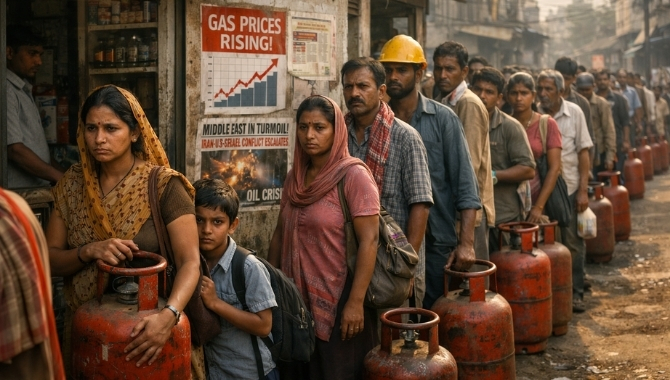
It has been over two weeks since the conflict in the Middle East involving Iran, United States, and Israel intensified, pushing the region into a level of uncertainty. The escalating hostilities have disrupted stability across the region and created widespread concern in global energy markets. This ongoing Iran war has drawn global attention as countries monitor its potential economic consequences.
The turmoil and destruction in the Middle East have triggered a severe global energy and fuel crisis. Prices of key commodities have begun to rise sharply, with markets experiencing volatility and uncertainty as supply chains come under pressure. Analysts believe that the Middle East conflict could significantly reshape global trade and energy security in the coming months.
As of mid-March 2026, Brent crude prices have surged above $105 per barrel — the highest level since July 2022 — as the US-Israel conflict with Iran enters its third week. The steep rise in prices is driven by concerns over potential damage to critical infrastructure on Iran’s Kharg Island, which accounts for nearly 90% of the country’s oil exports, along with the effective closure of the Strait of Hormuz, an important global oil transit route. This oil price surge has already begun to influence global inflation expectations.
Although the conflict is taking place thousands of miles away from India’s coastline, it has created anxiety among policymakers in India. Authorities are urgently exploring alternative trade routes and seeking to secure energy supplies from countries with proven petroleum reserves to avoid disruptions. Policymakers are closely monitoring the situation because the global energy market remains highly sensitive to developments in the region.
For India, the situation carries the risk of turning into a major energy challenge. The country imports nearly 60 percent of its LPG requirements, and a large portion of this supply normally passes through the Strait of Hormuz, one of the world’s most important oil transit routes. Any disruption in this corridor can have a direct impact on energy availability in India. Experts warn that a Strait of Hormuz disruption could directly affect fuel supplies across Asia.
As a result, commercial kitchens across the country are already beginning to feel the pressure. Reports from several cities suggest that people are standing in long queues to refill LPG cylinders. Online booking platforms have also experienced unusually high demand, with systems reportedly slowing down or crashing due to the surge in requests. These developments highlight the growing LPG shortage in India as demand rises rapidly.
The government has responded by limiting the supply of commercial cylinders—primarily used by restaurants, small eateries, and the hospitality industry—to around 20 percent of the usual allocation. This step is intended to prioritize household consumption, but it has created operational challenges for many businesses. Industry observers say this measure reflects the broader energy crisis in India linked to global developments.
Restaurants and commercial kitchens are facing shortages of LPG as well as LNG/PNG supplies. Many establishments have been forced to shorten their operating hours, reduce menu offerings, or temporarily shift to electric or traditional cooking methods. The ongoing disruption has also highlighted the vulnerability of the Indian food service industry during major energy supply shocks.
Major metropolitan cities such as Bengaluru, Mumbai, and Chennai are reportedly experiencing significant shortages. Some restaurants have partially shut down operations, while others have reduced their menus. In several places, there are even reports of a “dosa and samosa crunch,” as commercial kitchens struggle to prepare foods that require high-temperature cooking due to limited gas supply. This situation reflects the deeper cooking gas crisis in India emerging due to supply constraints.
While household LPG supply has been given priority, rising global prices could still trigger inflationary pressures on essential cooking fuel. If the conflict continues, rationing of cooking gas may become a possibility. Economists warn that this could contribute to fuel inflation in India if international oil prices remain elevated.
The ongoing conflict in the Middle East is likely to impact every segment and sector of the Indian economy. In fact, India ranks among the most vulnerable economies globally in the event of an oil shock. The escalation of the Iran–Israel conflict therefore has implications far beyond the region itself.
Nearly 90 percent of India’s crude oil requirements and about 50 percent of its natural gas needs are met through imports. As a result, the conflict has the potential to slow down the country’s growth momentum, especially since India’s current oil reserves are estimated to cover only around 20 to 25 days of consumption. This heavy dependence highlights India’s oil import dependence in times of geopolitical crisis.
It is in India’s best interest that the conflict comes to an end at the earliest, as a prolonged crisis could adversely affect the economic growth momentum the country has achieved in recent years. A continued escalation of the Middle East oil crisis could therefore have lasting consequences for India and the global economy.
Written by: EBS Consultancy Group
Latest Blogs
-
 Southwestern Company: The World's First Direct Selling Business
-
 Why Your Bank and UPI App Are Powering India's $5 Trillion Ambition
-
 Leaders as Growth Catalysts
-
 Investor Relations Support
-
 Initiating the Dialogue: Business Growth Through Regulatory Brand Building
-
 Igniting Innovation and Creative Thinking
-
 Enhancing Human Potential Through Synchronization of Organizational Goals
-
 Challenges and Opportunities in Building a Regulatory Brand
-
 A Comparative Analysis of FMCG and Direct Selling Industry
-
 Mastering India’s Regulatory Ecosystem for Sustainable Business Growth
-
 How Regulations Shape India’s Economic and Governance Landscape
-
 The Importance of Regulatory Brand Building in the 21st Century Knowledge Economy
-
 How to do sales during Pandemic
-
 Global Stock Market Reaction to the Middle East Conflict
-
 Sharpen Your Common Sense & Presence of Mind
